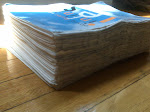
Friday, January 6, 2012

Don DeLillo, Lenny Bruce, Bob Dylan, Don Gately, David Foster Wallace, Mom and other shores

Inevitably I return to Infinite Jest.

Here's how it happened this time:

I'm nearing the end of reading Don DeLillo's Underworld - a fabulous book given to me by - of course - the Abbot - the man who started me on this Infinite Jest business in the first place.

And I'm captivated by DeLillo's Lenny Bruce stuff - fantastic stuff - so I look up Lenny Bruce online. I read about him, his life as brilliant comic and tortured soul and see in a list of Google results that there's something about him at BobDylan.com.

And who can resist Dylan?

So I click. And the click takes me to > the lyrics to Dylan's "Lenny Bruce" song and I go about reading all the lyrics and one line really hits me: "He's on some other shore, he didn't wanna live anymore."

And then I think immediately about Don Gately because I've never forgotten.

Never forgotten how it all ended.

I recall my theory about the ending.

The Gately ending.

The Gately "death".

My theory about Gately's "death"?

Well my theory is that David Foster Wallace did not have Gately "die" and he certainly didn't have him survive that horrible final scene - but instead put him in some kind of afterlife or at least another dimension - attaching him to some string theory world.

The way Dylan put Lenny Bruce on some other shore because Lenny Bruce didn't want to live anymore?

Dylan seems to me to want to look after Lenny in the song.

So I'm wondering did Wallace want to look after Gately too - in his book?

Which then makes me wonder if this post is me trying to look after someone too.

Like maybe even looking after David Foster Wallace himself. Is this post me putting him on another shore and making him not "dead"?

Or maybe it's about my Mom? No - not "the Moms". My Mom.

I started reading DeLillo's Underworld the day I took my Mom to the hospital for surgery a couple of months ago. They put her under and cut her open to try to fix her heart but she never came to. "Gone." Just like that. A complete surprise to me. And probably a surprise to her too. Went into the operating room and never came back. It was like she vanished. Sure - her body didn't vanish. They let me see her body. But it felt like she kind of "escaped".

That's what I'm thinking - now that I've gone down this path of "investigation".

And I'm wondering: Do DFW and Bob Dylan really want us to believe that like Don Gately and Lenny Bruce, others could be on infinite other shores? Other dimensions? Personal dimensions?

But that sounds almost like, well, almost like g/God and religion and stuff like that.

Come on - everyone who knows me, knows I don't believe in such fiction. Could Wallace have believed in something like that? Like there was something more? After? Or beyond? Beyond this earth, beyond the written page, beyond the one-man show, beyond the lyrics in a Dylan song?

While I agree that it could be argued that like Lenny Bruce and David Foster Wallace, my Mom didn't want to live any more, do Wallace and Dylan really want me to believe that when my Mom came back to, she was flat on her back on a beach in the freezing sand, and it was raining out of a low sky, and the tide was way out?

You know - I've been determined to finish the rather hefty and long Underworld as a kind of tribute to my Mom and in the hope of possibly finding some kind of comforting message in the book that my Mom might magically have left me but I'm amazed that Underworld has taken me along some crazy paths back to Infinite Jest.

Always Infinite Jest.

It's probably just me. It's probably just me looking for that magic. Magic in a book, magic in life.

Magic doesn't happen, right?

Fiction doesn't happen, right?

Sunday, August 22, 2010

The Brothers K

Just finished reading BK, one year after IJ. Read it because of IJ and
DFW and because the Abbot told me to. Very happy that I did. Never
read Dostoevsky before. Hard to believe now. Great, great writer. And
a very important book. I can see now why people called it the great
modern book and Dostoevsky the great psychologist. But he is more than
that. I also really loved his sense of humour and playfulness as a
writer. Reminds me of DFW. It is clear to me that DFW drew heavily on
Dostoevsky and the novel itself...

Friday, December 25, 2009

Open Present

Merry Christmas. Infinite reading.

Wednesday, September 2, 2009

Pencil Marks In Stephen Burn's Reader's Guide To Infinite Jest:


This transcription of my pencil marks may not make sense to you but they do make some sense to me:

(Burns is in black. I am in red.)

Page:

12 - the kind of emptiness in high talent that Wallace found at the end of his mathematical career


14 - idea of art being a living transaction between humans


15 - his goal of human connection


19 - flows of data more vast than anything the world has seen before


- Ulysses - a kind of encyclopedia


- Joyce - an attempt at "containing the encyclopedia"


20 - "scrotum-tightening", "telemachry"


- the novel is stalked by the ghost of a tall alcoholic author named Jim


29 - his aim is not linear simplification, but to show how one story has "to do with a context created by a larger narrative system of which this piece was a part".


- Infinite Jest's three narratives are designed to suggestively interact, illustrating how individual action effects and is shaped by a larger community


39 - search for an adequate understanding of the self


- "who's there?"


- cold room


- "I am in here."


- empty


40 - somebody unresponsive is there


- no matter how expansive your vocabulary, or how careful your description, a list of words is not enough to make a self


41 - "neither quite a nerd nor quite a jock"


42 - Hal has understood himself "for years as basically vertical," and as his lack of depth begins to depress him...


43- Arizona Garage Scene between James O. Incandenza and his father


- Perhaps most importantly Infinite Jest is a novel that explores the different ways "fathers impact sons"


- "you're a machine"


- seminal definition of what a self is


44 - Wallace attempts to do something real American


46 - Self-forgetting


- The Show


47 - Gaudeamus Igitur: let us rejoice


49 - Hal feels at his own face to see if he's wincing


- insufficient free will


50 - charts the progressive erasure of identity by the pressures of family and academy


51 - beginning with a confident "I" the narrative proper ends with "he"


52 - Erdedy reflects on the light streaming onto the floor (the way I did when I put Mount Jest on the floor of my room? Am I a pot head?) and on the insect (take note Abbot)


53 - To locate the local in larger perspectives


- cool analysis: Burn refers to the coffee cup that knocks on the door ("like the rap of a knuckle", p. 480) of Antitoi Entertainment as Gately drives by the place that houses the Infinite Jest cartridge that he originally stole: Burn likes this small narrative circle (for those who don't believe that there was no narrative line at all, Burn demonstrates how in one small, tight moment, Wallace is able to bring the narrative together then loop of again


54 - emergent networks


- "systems inside systems" of natural ecologies


55 - a novel that is partly about the returning dead


- Robert Coover's The Universal Baseball Association


56 - Wallace does seem to have attempted to create a mythology


57 - Madame Psychosis = metempsychosis: migration of the soul from one body to another


- there is little in this long book that does not serve some larger purpose


- parallels between Heracles and Gately


58 - during the "missing year" between YDAU (2009) and Glad (2010): "Don Gately and I dig up my father's head."


(Hmm - is Gately alive then? Or maybe this explains why Hal finishes the story speaking like the devil and blowing his admissions interview: he has been to hell/the Underworld?; he has been with Gately? Is Gately now the ghost? And is Himself the head/skull of Yorrick > "a fellow of Infinite Jest (the film)? (In Hamlet the ghost was apparently in Purgatory - like maybe Gately?))

59 - Dymphna is a Catholic saint


60 - raises the possibility that Infinite Jest is basically a religious book


- the novel is about belief


- the spiritual hollowness of a life without belief seems to be one of the most persistent themes


- Wallace interview with Review of Contemporary Fiction: "To me, religion is incredibly fascinating as a general abstract object of thought - it might be the most interesting thing there is. But when it gets to the point of trying to communicate specific or persuasive stuff about religion, I find I always get frustrated and bored. I think this because the stuff that's truly interesting about religion is inarticulable." (Is this like Einstein's view of religion?)


61 - the novel intimates that belief may provide, as the last words hint, a "way out" (or the answer is way out there?)

64 - festival of the dead


65 - Infinite Jest is clearly a book with "wide-ranging and deeply hidden themes having to do with death and time"


- narratives clearly move toward an apocalyptic collision


- 2010 is the very last year of ONANite Subsidized Time


68 - Kakutani of the New York Times said that the book "often seems like an excuse for Mr. Wallace to simply show off his remarkable skills as a writer and empty the contents of his restless mind".


74 - Cioffi's essay talks about the experience of reading the book


75 - Joseph Tabbi's Cognitive Fictions provides an interesting response to earlier criticism as it breaks with the prevailing trend of considering IJ as an extension of Pynchon's work


76 - Zadie Smith expressed admiration for Wallace's work: "Wallace is proving to be the kind of writer I was sort of hoping didn't exist - a visionary, a craftsman, a comedian and as serious as it is possible to be without writing a religious text"


(Nice words from Zadie. It's true: vision, craft, high humour, seriousness - but clearly not dogmatic like the Bible - given the elussive narrative, the inconclusive ending and the creation of a book that is more puzzle and game than it is two stones being brought down from a mountain.)


---


Burns gets at a lot of stuff that I didn't make note of with my pencil marks. The pencil marks were I guess more personal than explaining what Burns concludes. (I guess you'll have to read that for yourself!) Burns does a very good job in a very few pages in putting IJ in a literary context - making interesting references to writers and books that IJ was maybe based on or better yet tried to contain. Burns talks a lot about Joyce and Ulysses and DeLillo and Underworld. Burns also does a good job of clarifying the narrative and the timeline in IJ. A worthwhile quick read. Thanks Abbot!

Days of Essays

Book holding open book.

Is there a lovelier sight than that?

Book forcing open book.
Splaying book.
Forcing another book to speak.
To attempt - attempt - to speak the truth.
To reveal the mystery of another.

In the photo, the book being held open is the Guide to the book that has it trapped.

This is a sweet remembrance of times past. Of university days. And of writing essays at night - with books piled on top of each other, here, there and everywhere - bathed in an amber light.

An orgy.

(Cue music: "Gaudeamus Igitur...")

Monday, August 31, 2009

Neighbourhood Bookshop Closes

Was a nice little shop. I tried to go in often just for the feel of it. But they didn't always have what I wanted - for instance: Infinite Jest For Dummies.

Outdoors With Guide

Upto page 53 now. Turns out I couldn't just read a few. I had to read 50 plus. Obsessed - but my return to the Education Ministry and my machine-like existence - on Wednesday - should quell my fanaticism.

Btw - some cool analysis here Abbot. Have you read this guide yourself?

Btw2 - the insect appears on page 17, Abbot.

Another Gift From The Abbot

A Reader's Guide to Infinite Jest. By Stephen Burn.

Thanks very much Abbot. Good thing I bumped into you in the real-not-virtual-world. As I mentioned to you, IJ has so sparked me as a reader that I have become a regular at Amazon and local bookstores - and I therefore didn't initially know that this book was from you when it arrived in cardboard at my door.

Question is should I start reading it? Right now I am in the middle of reading both the Inferno and Purgatory and The Brothers Karamazov looks longingly at me from my bedside every night.

I may opt for the approach that Mr Ashdale spoke of a while back - especially now that I've earned my spurs by finishing IJ - which is to just read what I feeling reading and books will get "finished" when they get finished.

In keeping with this it has also occurred to me that all of the books ever written and that will be written represent one big book any way. One big book. One big story. All books and stories are linked some way or another, in ways big and small, obvious and subtle.

So maybe I'll just read a page or two of the guide...

Friday, August 14, 2009

Rearranged String: Jest As Gift:

Pages still loose and free. But kept secure and looking gift-like as the Abbot intended.

Taking Down The Jest

It was time. I never warmed up to this little experiment. I think it kind of freaked out the Blonde Woman. Got her "concerned" about me. But I'm ok. More than ok - especially when I think about Gately. He could take anything - incredible pain. And imagine the kind of pain DFW had to endure. Clinical depression is bad (Just ask Kate Gompert). Poor guy. He couldn't have wanted to die. From what I understand he finally got his girl/his Joelle - and had a nice home, a dog - a life.


I doubt very much that he ended up in Dante's 7th Circle of Hell. That old-school religious mythology is still pretty cool and instructive and well written but I think DFW was treading on something closer to the truth when he tried to marry math and science and philosophy: the idea that everything is connected (maybe by strings) and that there might be more dimensions, something more than this.


If DFW is in fact still conscious, I hope that by now he has lifted himself up from that cold, wet, gray beach that he imagined and has climbed up to that place of incandescent light he so richly deserves.

Tuesday, August 11, 2009

Gately in Purgatory?


The Purgatory?

A kind of Purgatory?

Dante's Purgatory?:

(Recall how we left him dear Abbot: "And when he came back to, he was flat on his back on the beach in the freezing sand, and it was raining out of a low sky, and the tide was way out."))

(Forgive the long quote (From Danteworlds)):

'More so than for Hell and Heaven, Dante has significant leeway in imagining and representing this realm of the Christian afterlife. While there is no specific reference to a place called "Purgatory" in the Bible, the concept took shape over the course of early Christianity and the Middle Ages on the basis of biblical support for what would later become Purgatory. (This concept has been a major point of doctrinal disagreement since the Protestant Reformation and Catholic Counter-Reformation.) Thus Judas Machabeus, honoring the custom of offering prayers for those who died in God's grace, proclaims that it is "a holy and wholesome thought to pray for the dead, that they may be loosed from sins" (2 Mach. 12:46). The idea of trial by fire, another important conceptual component of Purgatory, figures prominently in the Bible: "Thou hast proved my heart," sings the psalmist, "and visited it by night, thou hast tried me by fire: and iniquity had not been found in me" (Psalm 16:3). John the Baptist, who baptizes in water, prophesies the greater power of Jesus, saying "[h]e shall baptize you in the Holy Ghost and fire" (Matt. 3:11). Based on these and other passages, medieval theologians introduced the idea of 'purging fires' as a way to imagine the purification of souls who died in God's grace but bore the stains and habits of sin. From the adjective purgatorius arose the noun Purgatorium as the concept of Purgatory received full theological legitimation in the mid- to late thirteenth century (e.g., at the Second Council of Lyons in 1274). The elaboration of this concept can also be seen in depictions of the afterlife in popular visionary literature of the Middle Ages before Dante. (See Visions of Heaven and Hell before Dante, ed. Eileen Gardiner [New York: Italica Press, 1989].) The author of "Drythelm's Vision" (7th century) speaks of "consuming flames and cutting cold" that punish certain souls; helped by prayers, alms, fasting, and masses, "they will all be received into the Kingdom of Heaven at the Day of Judgment" (61). "St. Patrick's Purgatory" (mid 12th century) describes harsh punishments to purge souls of their repented sins and thus enable their return to the same terrestrial paradise from which humanity was banished (144). The "Monk of Evesham" (end of 12th century) also describes harsh, cruel torments; nonetheless, "[b]y atoning for their crimes or by the intercession of others, in that place of exile and punishment, they might earn admission to the heavenly country" (204). And in "Thurkill's Vision" (dated 1206), the souls pass through a "large purgatorial fire" and are immersed in a lake "incomparably salty and cold" (222). Elements from both theological authorities and popular accounts--including painful (if fitting) torments, at times tempered or shortened by prayers and good works of the living--certainly inform Dante's Purgatorio. However, the poet creates the world's most enduring image of this second realm of the afterlife by fully developing the concept of purgatory in the way we would expect: meticulous geographical and topographical representation of the region; sophisticated application of sources that both reinforces and challenges received dogma; subtle psychological portraits of its inhabitants; dramatic interactions between these characters and Dante himself as well as between Dante and his guide, Virgil; and creative opportunities for trenchant social, moral, and political commentary on the world of the living. Of particular conceptual originality is Dante's Ante-Purgatory, the region rising from the shore at the mountain's base to the gate of Purgatory proper at the limit of the earth's atmosphere. This area is populated by souls who were excommunicated by the Church or who for various reasons delayed repentance to the end of their lives. '


Strung Up Jest

With afternoon storm clouds in background, thunder rolling in. And now - rain spattering on roof. And yes - lightning: flash. Roar. Spatter, spatter. Roar. Flash. Roar. Flash, flash.

11-a-side


In theoretical physics, M-theory is a new limit of string theory in which 11 dimensions of spacetime may be identified. Because the dimensionality exceeds the dimensionality of five superstring theories in 10 dimensions, it is believed that the 11-dimensional theory is more fundamental and unifies all string theories (and supersedes them). Though a full description of the theory is not yet known, the low-entropy dynamics are known to be supergravity interacting with 2- and 5-dimensional membranes.

This idea is the unique supersymmetric theory in eleven dimensions, with its low-entropy matter content and interactions fully determined, and can be obtained as the strong coupling limit of type IIA string theory because a new dimension of space emerges as the coupling constant increases.


String Theory:

Uplifting?

No - this doesn't look right. As you can see I've suspended the now tied-up pages of IJ from a ceiling hook. I thought that perhaps to have the pages in the air, or moving "up" toward the heavens would capture the power of the book. But I get nothing inspiring from this, nothing beautiful and nothing close to an image of string theory.

The string should do it:

But something doesn't seem right here. Can you really tie down a mountain? Such a colossus of pages? Such ideas and spirit? The strings ought not be a new cage. Could the strings somehow keep together yet retain the grand and uplifting quality of IJ? Uplift?

For Immediate Release: the Abbot of Theleme joins Readinginfinitejest.com:

Blog founder John Vivant is pleased to announce that the Abbot of Theleme has joined Readinginfinitejest.com:

"The esteemed Abbot of Theleme is a welcome addition to our team. In fact, the Abbot was not only an early reader of The Book but perhaps its greatest celebrant; a herald really. It was the Abbot who brought The Book, The Thick Book, to my attention and pressed me repeatedly to read it. Having now finally read it, I have to say that The Book is one of the greatest gifts I have ever received. Perhaps life altering. To see the Abbot's name now among the list of contributors to the blog has giving me cause to rejoice..."

String Theory?

Perhaps some string will help allay the powerful pull of the planet's rotation on the spineless pages?

La Porte de l'Enfer


I'm finally in.